
Quick answer: A well pump moves water from your well to your house. In most homes, an electric pump pushes water up from the well into a pressure tank. The tank stores the water under pressure. When you open a faucet and the pressure drops to a preset level (the cut-in pressure), a pressure switch turns the pump on. When the tank refills and reaches the cut-out pressure, the switch turns the pump off. The two main pump types are submersible pumps (installed underwater in the well) and jet pumps (installed above ground).
In this guide
- The parts of a private well system
- How water gets into the well
- The pump cycle, step by step
- How a submersible pump works
- How a jet pump works
- Submersible vs. jet pump at a glance
- The pressure tank and pressure switch
- Other components that keep the system running
- Sizing: flow rate, head and horsepower
- How long a pump lasts and what shortens its life
- Basic maintenance and safety
- Glossary
- FAQ
1. The Parts of a Private Well System
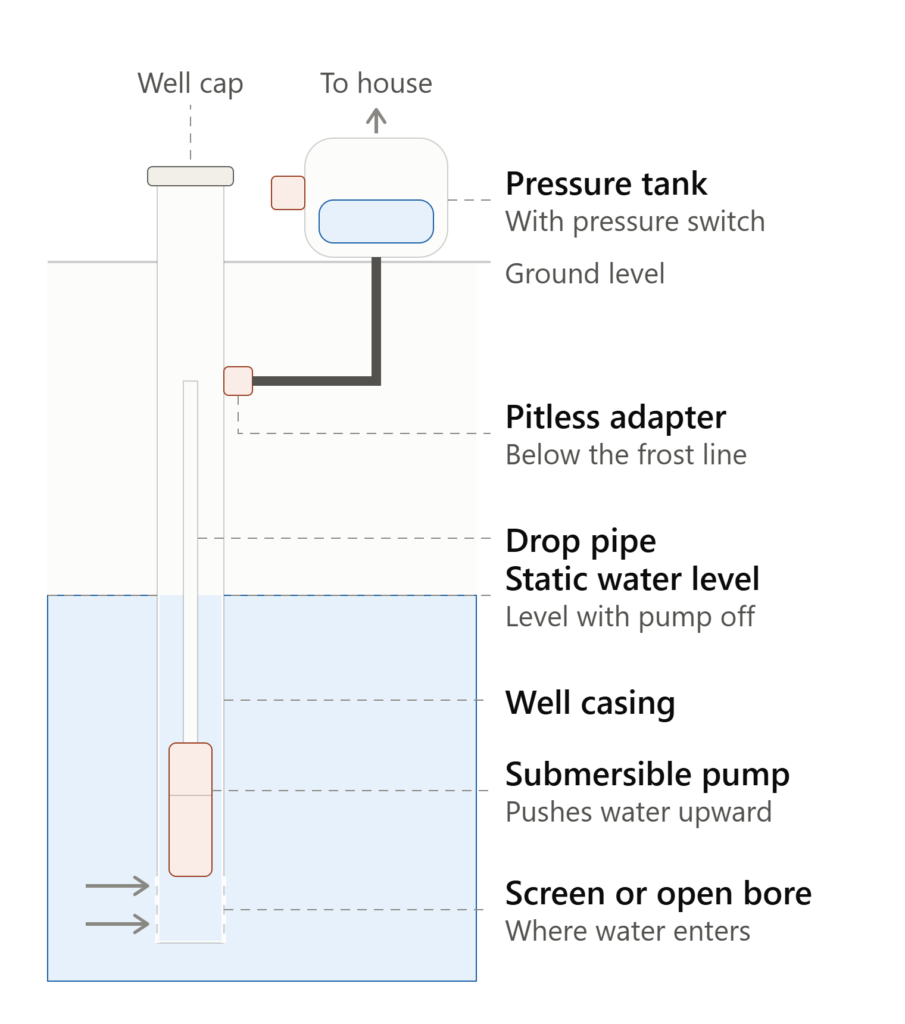
A private well is a small water utility in your own yard. Before looking at the pump, it helps to see where it sits in the whole system.
| Component | What it does |
|---|---|
| Well casing | A steel or PVC pipe that lines the borehole and keeps soil and surface water out |
| Well cap (sanitary seal) | A vented, sealed cap on top of the casing that blocks insects, debris and contaminants |
| Pump | Moves water from the well to the home (submersible in the well, or jet pump above ground) |
| Drop pipe | The pipe that carries water up from a submersible pump |
| Pitless adapter | A fitting that connects the drop pipe to the underground water line below the frost line, without a pit or opening |
| Check valve | Keeps water from flowing back down into the well when the pump stops |
| Pressure tank | Stores pressurized water so the pump does not turn on every time you open a faucet |
| Pressure switch | Turns the pump on and off based on system pressure |
| Pressure gauge | Shows the current system pressure in PSI |
| Control box (some submersibles) | Houses the starting capacitor and relay for 3-wire pump motors |
| Electrical wiring and breaker | Supplies power, usually 230 volts, and protects the circuit |
2. How Water Gets Into the Well
Underground, water fills the spaces between soil, sand, gravel or fractured rock. This saturated layer is an aquifer. A well taps into it.
- In sand or gravel formations, a well screen (a slotted pipe) lets water in while keeping most sediment out.
- In bedrock wells, the lower part of the borehole is often left open, and water seeps in through fractures in the rock.
Three terms matter for understanding how your pump behaves:
- Static water level: how far below the ground the water sits when the pump is off.
- Drawdown: how much the water level drops while the pump runs.
- Recovery rate: how quickly the level climbs back after pumping stops.
If the pump removes water faster than the well can refill it, the water level drops to the pump intake and the pump begins to suck air. This is why a pump must match the well’s capacity (Section 9), and why a drought can make a well run dry.
3. The Pump Cycle, Step by Step
Here is what happens every time you use water.
- The tank holds pressurized water. Say your switch is set to 40/60 PSI. The tank is full at 60 PSI.
- You open a faucet, run the dishwasher or flush a toilet. Water leaves the tank and pressure begins to drop.
- Pressure reaches the cut-in point (40 PSI). The pressure switch closes its contacts and sends power to the pump.
- The pump starts. It pushes water up the drop pipe, through the pitless adapter and into the tank and house.
- Pressure rises as the pump runs. If you are using water, the pump supplies it directly. Any extra goes into the tank.
- Pressure reaches the cut-out point (60 PSI). The switch opens its contacts and the pump stops.
- The check valve closes, keeping the water in the pipes and tank.
- The tank supplies water again until the pressure falls back to cut-in, and the cycle repeats.
A healthy pump might run for a minute or two at a time, a handful of times per hour during active use, and not at all when nobody is using water.
4. How a Submersible Pump Works
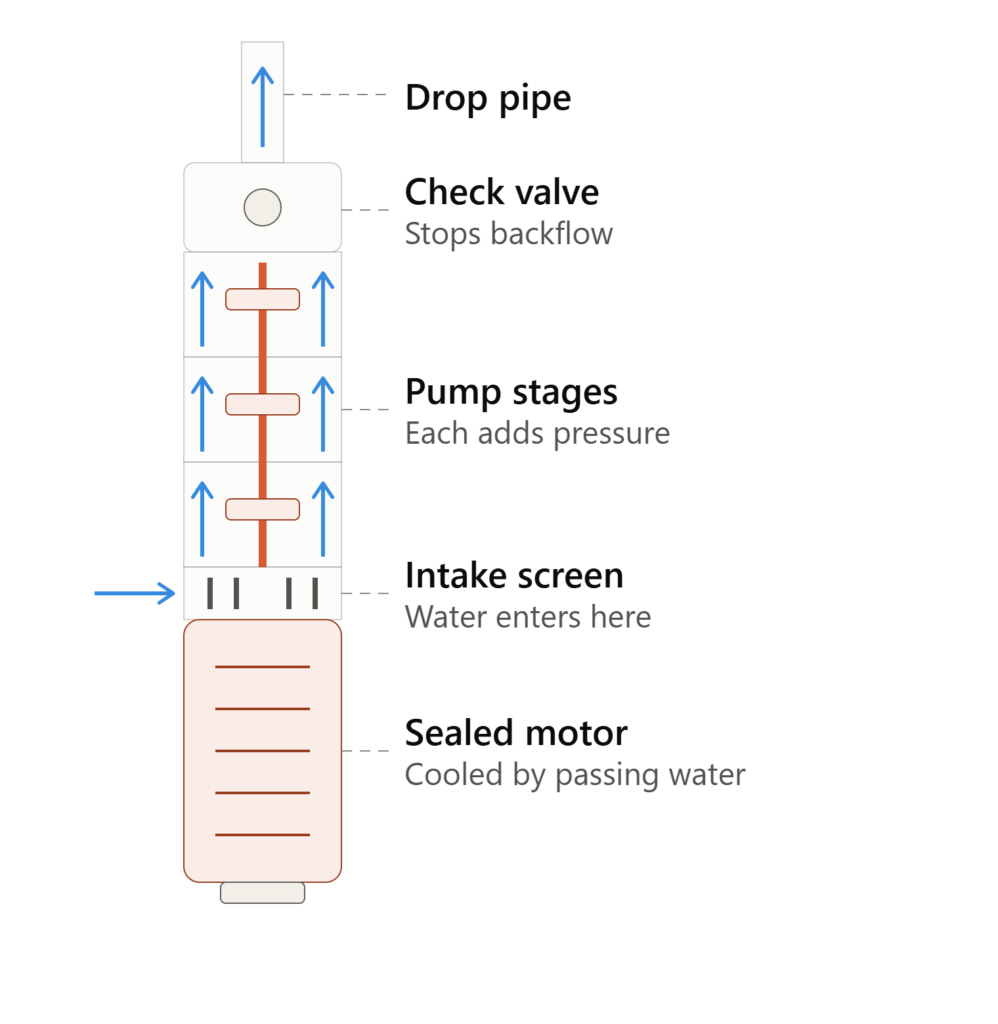
A submersible pump is a long, slim cylinder, about 3 to 4 inches in diameter for most residential wells, lowered into the well below the water level. It has two sections:
- The motor (bottom): a sealed electric motor, cooled by the water flowing past it.
- The pump end (top): a stack of impellers and diffusers, called stages.
What happens inside:
- Water enters through an intake screen at the bottom of the pump end.
- The motor spins a shaft connected to the impellers.
- Each impeller spins the water outward, increasing its speed and pressure.
- A diffuser behind each impeller redirects the water into the next stage, where the process repeats.
- Each stage adds pressure. More stages mean more lift. This is how a deep-well submersible can push water hundreds of feet up.
- Water exits at the top and moves up the drop pipe.
Why submersible pumps dominate:
- They push water instead of pulling it, which is far more efficient for deep wells.
- They are quiet, because the pump is underground.
- They do not need priming, because they are always underwater.
- They work for wells from about 25 feet to more than 500 feet deep.
2-wire vs. 3-wire: A 2-wire submersible has its starting components inside the motor, so it connects directly to the pressure switch. A 3-wire pump uses an above-ground control box with a start capacitor. The control box makes motors easier to service, because the parts that most often fail are accessible without pulling the pump.
Where it sits: The pump should hang well below the lowest expected water level, typically 10 to 20 feet or more above the bottom of the well, so it is not drawing in sediment. It is attached to the drop pipe, with a safety rope and, often, a torque arrestor, which prevents the pump from twisting against the casing when it starts.
5. How a Jet Pump Works
A jet pump sits above ground, in the basement, a well house or a utility room. Instead of pushing water from below, it uses suction and a clever device called an ejector (or jet).
Shallow-well jet pumps (single pipe)
- A pipe runs from the pump down into the well.
- The pump’s impeller creates suction, drawing water up the pipe.
- Part of the water is sent back through a nozzle and venturi (the jet), creating extra suction that helps lift more water.
- Atmospheric pressure pushes the water up toward the pump. This only works to a limited height. In practice, shallow-well jet pumps are limited to wells where the water is about 25 feet or less below the pump.
Deep-well jet pumps (two pipes)
For deeper wells, the ejector is placed down in the well, and two pipes run to the pump: one pushes pressurized water down to the ejector, and the other brings the mixed flow back up. These can handle water levels up to roughly 100 to 120 feet, but they lose efficiency as depth increases.
Jet pump characteristics:
- Easier and cheaper to service, because the pump is accessible.
- Noisier, because the motor is inside or next to the home.
- Must be primed (filled with water) before running. Losing prime is a common failure.
- Less efficient than submersibles, especially in deeper wells.
- Often found in older homes, shallow wells and dug or driven wells.
6. Submersible vs. Jet Pump at a Glance
| Feature | Submersible pump | Shallow-well jet pump | Deep-well jet pump |
|---|---|---|---|
| Location | Inside the well, underwater | Above ground | Above ground, with ejector in the well |
| Practical well depth | About 25 to 500+ feet | Up to about 25 feet to water | Up to about 100 to 120 feet to water |
| Efficiency | High | Moderate | Lower |
| Noise | Very quiet | Louder | Louder |
| Priming needed | No | Yes | Yes |
| Service access | Difficult: must be pulled from the well | Easy | Moderate |
| Typical lifespan | Roughly 8 to 15 years | Roughly 8 to 12 years | Roughly 8 to 12 years |
| Typical equipment cost | $200 to $1,500+ | $150 to $600 | $250 to $900 |
Costs and lifespans vary with brand, horsepower, depth and installation. For full numbers, see our guide to well pump replacement cost.
7. The Pressure Tank and Pressure Switch
Why you need a pressure tank
Without a tank, the pump would start every time you opened a faucet and stop when you closed it. That constant cycling wears out the motor quickly. The tank stores water under pressure so the pump can run in longer, less frequent cycles.
How a bladder or diaphragm tank works
Inside the tank, a flexible bladder or diaphragm separates two chambers:
- Water side: fills as the pump runs.
- Air side: a charge of compressed air (or nitrogen) sits on the other side of the barrier.
As water enters, it compresses the air, raising pressure. When you open a faucet, the compressed air pushes the water out. The usable water between cut-in and cut-out is called drawdown capacity (or drawdown volume).
Precharge rule: Set the tank’s air pressure (with the system off and the tank drained) to 2 PSI below the cut-in pressure. For a 40/60 switch, the precharge should be 38 PSI. For 30/50, it should be 28 PSI. An incorrect precharge is one of the most common reasons for short cycling.
How the pressure switch works
The pressure switch is a small box, usually mounted near the tank, with electrical contacts inside. A diaphragm senses the water pressure. When pressure falls to the cut-in point, a spring-loaded mechanism closes the contacts and starts the pump. At cut-out, the contacts open and the pump stops.
Common residential settings:
| Setting | Cut-in | Cut-out | Notes |
|---|---|---|---|
| 30/50 | 30 PSI | 50 PSI | Most common standard setting |
| 40/60 | 40 PSI | 60 PSI | Higher pressure for larger homes or elevated fixtures |
| 20/40 | 20 PSI | 40 PSI | Common in older or low-pressure systems |
Warning: The pressure switch carries 120 or 240 volts. Do not open it or adjust it with the power on. See our guide to adjusting a well pressure switch safely.
8. Other Components That Keep the System Running
- Check valve: Submersible pumps usually have one built in at the pump discharge. Many installations add another near the pressure tank (and sometimes additional ones every 100 feet in deep wells). A failing check valve lets the pressure drop back and makes the pump cycle on and off.
- Pressure relief valve: A safety valve that opens if the system pressure goes too high.
- Pitless adapter: Connects the drop pipe to the underground horizontal line, which is buried below the frost line to prevent freezing.
- Torque arrestor: A rubber or plastic fitting that keeps the pump from twisting.
- Safety cable or rope: Holds the pump if a pipe joint fails.
- Constant pressure systems (variable frequency drives): Instead of a switch and a large tank, a VFD controller adjusts the pump speed to maintain a steady pressure, for example 60 PSI, regardless of how many fixtures are running. They cost more upfront, but give consistent shower pressure, less motor stress and a smaller tank.
9. Sizing: Flow Rate, Head and Horsepower
A pump that is too small leaves you short of water. One that is too large can pump the well dry or cycle too often. Three numbers decide the right pump.
1. Flow rate (GPM): Gallons per minute the pump must deliver at peak demand. A typical household needs about 8 to 12 GPM to run a couple of fixtures at once, and larger homes or irrigation need more. Your pump’s flow must also stay below the well’s yield (how much the well can supply), which your driller’s well log or a flow test will show.
2. Total dynamic head (TDH): The total pressure the pump must overcome, expressed in feet. It combines:
- The vertical distance from the water level (while pumping) to the pressure tank,
- The pressure you want in the system (each 1 PSI is about 2.31 feet of head), and
- Friction losses in the pipes and fittings.
3. Horsepower: Residential pumps usually range from 1/2 HP to 2 HP, going up to 5 HP for deep wells or high demand. Horsepower is the result of the first two numbers, not the starting point. Do not buy a pump by horsepower alone.
Every pump has a pump curve, a chart that shows how many GPM it delivers at each level of head. A professional compares your needs against the curve to pick the right model.
Tip: If you are replacing a pump, find the information on the existing pump label, the well log or the driller’s records. Do not guess.
10. How Long a Pump Lasts and What Shortens Its Life
Most submersible pumps last roughly 8 to 15 years, and some last 20 or more when well cared for. Jet pumps are commonly in the 8 to 12 year range.
What shortens pump life:
- Short cycling (frequent starts and stops) from a waterlogged tank, wrong precharge or a failing check valve.
- Sediment and sand that wear impellers.
- Running dry when the well level drops below the pump intake.
- Electrical problems: low voltage, lightning, a faulty capacitor or loose connections.
- Corrosive or aggressive water (low pH, high iron or sulfur bacteria).
- An oversized or undersized pump for the well and household.
- Age and mineral buildup on moving parts.
Early warning signs:
- Pressure fluctuating or dropping at faucets
- Spitting or sputtering air from taps
- The pump running constantly or turning on and off frequently
- Higher electric bills
- Cloudy or sandy water
- No water at all
- A tripping breaker
If you see these signs, see our troubleshooting guides on pump problems, or call a licensed well contractor.
11. Basic Maintenance and Safety
Do-it-yourself checks (a few times a year):
- Look at the pressure gauge: does the pressure stay within the normal range and hold steady when no water is running?
- Listen for the pump cycle. Note how long it runs and how often it starts.
- Inspect the well cap for cracks and make sure it is tight and sealed.
- Check the area around the wellhead for standing water or erosion.
- Look for leaks or rust at the pressure tank, pipes and switch.
- Check the tank precharge once a year (with power off and the tank drained).
- Keep the area around the well and the pump house clear and dry.
Professional service:
- Have a well contractor inspect the system every few years, and sooner if you notice a drop in performance.
- Test your well water annually (see our guide: How to Test Well Water).
Safety first:
- Always turn off the circuit breaker before touching the pressure switch, control box or wiring.
- Do not try to pull a submersible pump without proper equipment. It is heavy, awkward and dangerous, and a mistake can drop the pump down the well.
- Do not open the well cap to inspect the well casually, as it can contaminate the water.
- Hire a licensed professional for pump replacement and electrical work. In many states, well pump work requires a license or permit.
12. Glossary
| Term | Meaning |
|---|---|
| Aquifer | Underground layer of water-bearing rock or sediment |
| Cut-in / cut-out | The pressures at which the switch turns the pump on and off |
| Drawdown | Drop in water level while the pump is running |
| GPM | Gallons per minute |
| Head | Pressure expressed as the height of a water column, in feet |
| Impeller | The spinning wheel that moves water in a centrifugal pump |
| Pitless adapter | A watertight fitting that connects the well to the underground water line |
| Precharge | Air pressure set in the tank when it holds no water |
| PSI | Pounds per square inch, the pressure unit |
| Short cycling | The pump turning on and off too frequently |
| Static water level | Depth to the water when the pump is off |
| Waterlogged tank | A tank that has lost its air cushion, causing rapid cycling |
13. FAQ
How does a well pump know when to turn on?
A pressure switch senses the water pressure in the system. When it falls to the cut-in setting (for example, 40 PSI), the switch closes and powers the pump. When it reaches the cut-out setting (for example, 60 PSI), the switch opens and stops the pump.
Does a well pump run all the time?
No. A healthy pump runs only when pressure falls below cut-in, usually for a minute or two at a time. If it runs constantly, there is a problem, such as a leak, a failing pump, a broken pipe, a stuck pressure switch or low well yield.
What is the difference between a submersible pump and a jet pump?
A submersible pump sits inside the well underwater and pushes water up. A jet pump sits above ground and uses suction (with an ejector) to pull water. Submersibles are more efficient and handle deeper wells; jet pumps are simpler to service and are suited to shallower wells.
Do I need a pressure tank?
Almost always, yes, unless your home uses a constant-pressure (VFD) system. The tank reduces pump cycling, extends pump life and provides a reserve of water.
How deep can a well pump pull water from?
A jet pump can only lift water about 25 feet by suction (shallow-well type) and roughly 100 to 120 feet with a deep-well ejector setup. A submersible pump can push water from several hundred feet.
How much electricity does a well pump use?
Usually modest. A typical residential pump runs only a small portion of the day, and costs commonly add up to a few dollars to around $20 a month depending on pump size, water use and your electricity rate.
Will my well pump work without electricity?
Not unless you have a generator, battery backup or a solar pump. See our guides on generators for well pumps and solar well pumps.
Can I replace a well pump myself?
A jet pump is a feasible DIY project for a competent person. A submersible pump should be left to licensed professionals due to electrical hazards, heavy equipment and risk of losing the pump in the well.
Related Guides
- Submersible vs. Jet Pump: Which Is Better for Your Well?
- Well Pump Replacement Cost in 2026 (By Pump Type and Depth)
- How Long Do Well Pumps Last? 7 Signs of Failure
- Well Pressure Tank Size Guide: How to Choose the Right One
- How to Adjust a Well Pressure Switch Safely
- Well Pump Short Cycling: Causes and Solutions
- Well Pump Won’t Turn On: 8 Causes and Fixes
- What Size Generator Do You Need to Run a Well Pump?
Sources
- U.S. Environmental Protection Agency: Private Drinking Water Wells
- National Ground Water Association: Well owner resources and well system basics
- University extension publications on private well systems and pressure tanks
- Manufacturer technical documents on pump curves and pressure tank settings
Disclaimer: This article is for general information. Well systems differ by location, equipment and local regulations. Electrical work and pump replacement should be done by a licensed professional. Always shut off power before inspecting any part of the system.